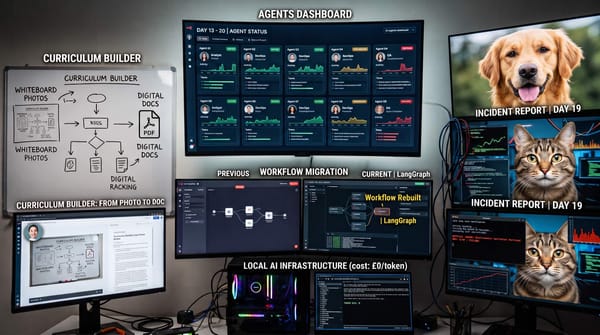
Seven days, three agents, and a system that ran while we slept
Seven days, three agents, and a system that ran while we slept
DAILY BUILD · MEMBER DIGEST 7 weekdays — 1 June to 9 June 2026
Here's everything built in week one of the 30-day AI-Run Business challenge — from architecture to production agents.

Build progress: 7 days done · 23 days to go · 23% complete
Week at a glance
| 3 agents built | 5 stack layers |
| <30s enrolment time |
Agents
Agent 01 — Lead Qualification ✓ Reads, scores, and enriches inbound leads overnight.
Agent 02 — Content Publishing ✓ Idea to live article in under 3 minutes.
Agent 03 — Enrolment ✓ End-to-end member provisioning, no human in the loop.
Day by day
Day 01 — Start here: what you've unlocked
Kicked things off with a clear statement of what the 30-day build actually is: a live, working AI-run business — every agent, tool, and mistake documented as it happens. One post every weekday. Three parts landing in May, June, and July. A vote board where members choose what gets built each week, with the top suggestion winning a build slot over the weekend.
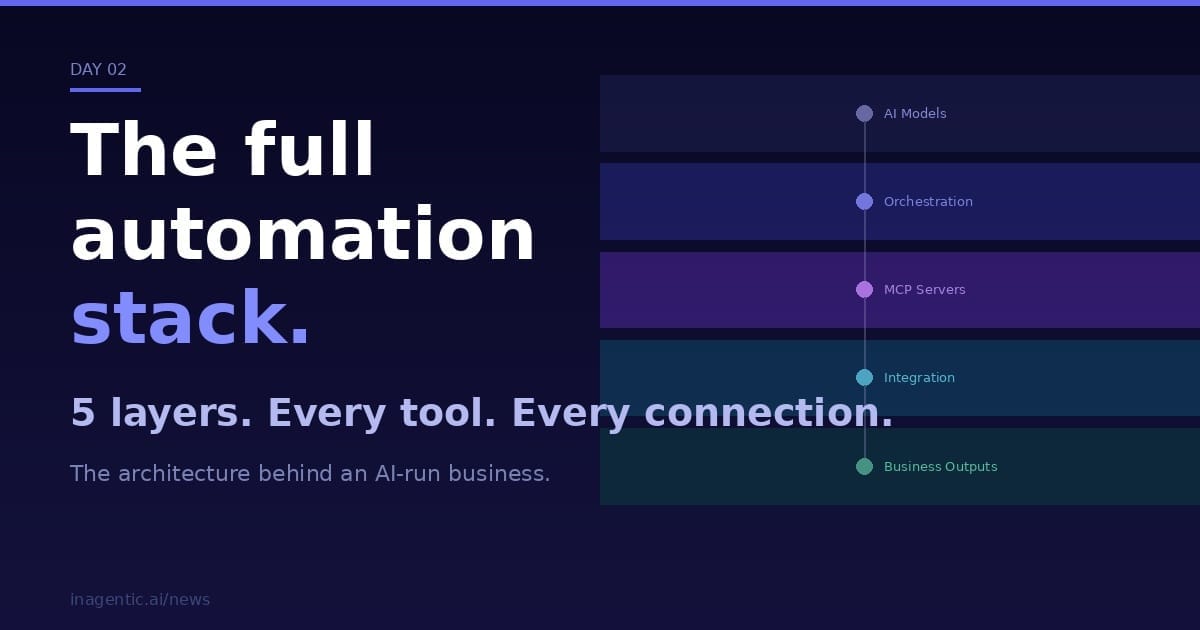
Day 02 — The full automation stack: five layers, one diagram
Mapped out the complete architecture before writing a line of agent code. Five layers, each with one job:
- L1 — AI Models: Claude Opus, Sonnet, Haiku via AWS Bedrock eu-west-1. Model selection is task-specific.
- L2 — Orchestration: LangGraph for workflows, LangChain for tool-calling, LangSmith for observability.
- L3 — MCP Servers: Model Context Protocol — tools Claude can discover and call at runtime.
- L4 — Integration Layer: REST APIs, PostgreSQL, Google Workspace, GitHub, Companies House, HMRC.
- L5 — Business Outputs: Filed documents, published articles, scheduled emails, compliance alerts.
"The model is the least interesting part of the problem. Most AI projects fail not because the model isn't good enough, but because there's no architecture around it."
Day 03 — Agent 1: Lead qualification in practice
The first agent reads every inbound message, scores it by intent and urgency, and enriches each lead with company context — funding rounds, headcount changes, recent news. Anything that tells you whether this is a good moment to be speaking to this person.
When a lead comes in and there's a recent funding round attached to that company, it goes straight to the top of the pile. Built in once, runs quietly in the background forever.
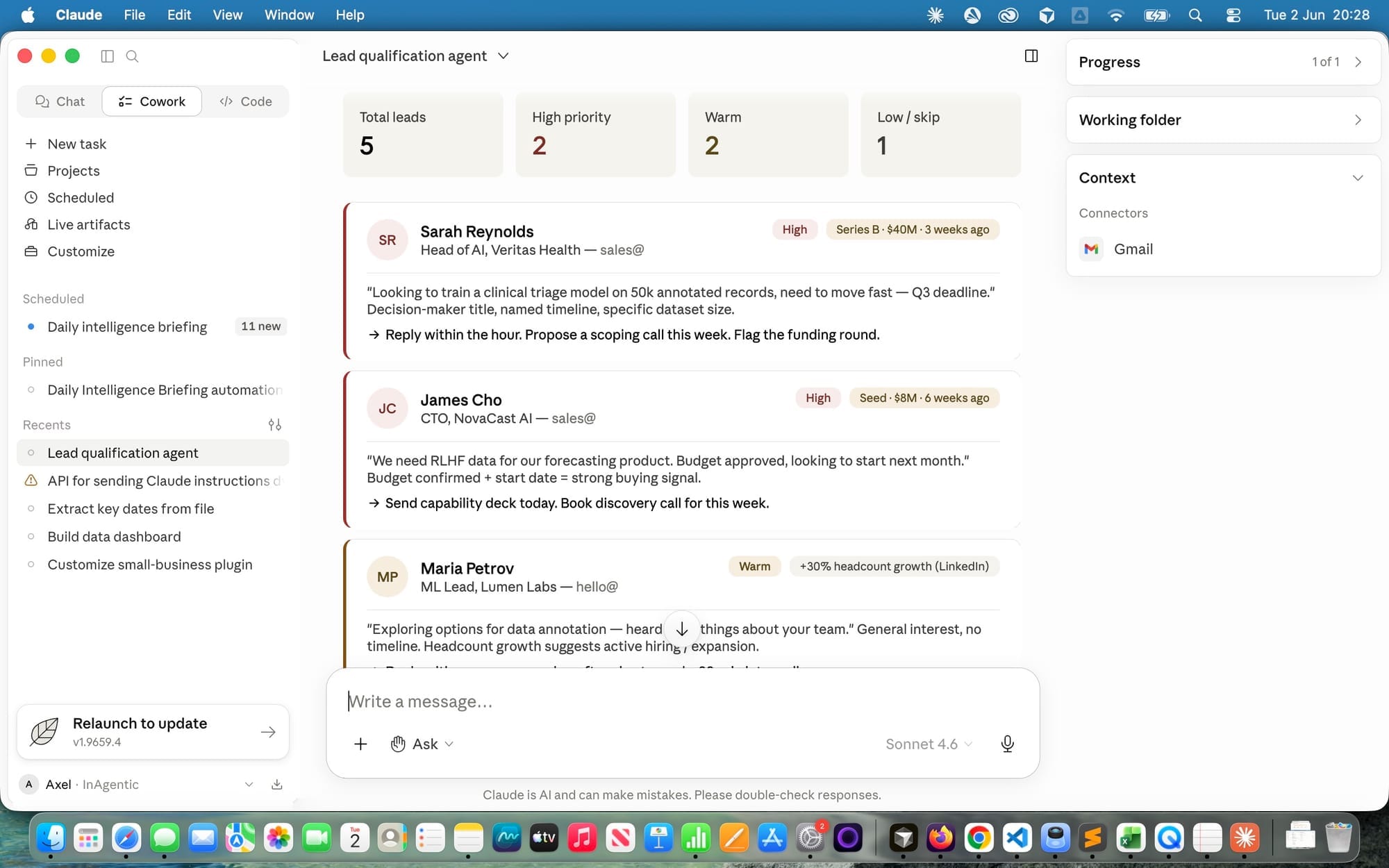
Also covered: the practical case for starting with Claude Desktop over LangGraph, and the full setup in under an hour — no code, no config files, no terminal.
Day 04 — Agent 2: Idea to live article in 3 minutes
The content publishing pipeline takes a topic from concept to published URL in a single automated workflow. Claude acts as writer, editor, and publishing coordinator. MCP servers connect directly to Ghost and FileDone — no copy-pasting between tools.
- Idea generation — Claude + web search returns 10 ranked topics with estimated traffic volumes.
- Write — Full article produced in ~20 seconds with MCP context attached.
- Edit — Audience targeting, year-freshness, and CTAs injected automatically.
- Deploy — FileDone MCP uploads and publishes in two tool calls. Ghost MCP syndicates simultaneously.
Days 05–07 — Agent 3: Enrolment, in three parts Part 1 · Part 2 · Part 3
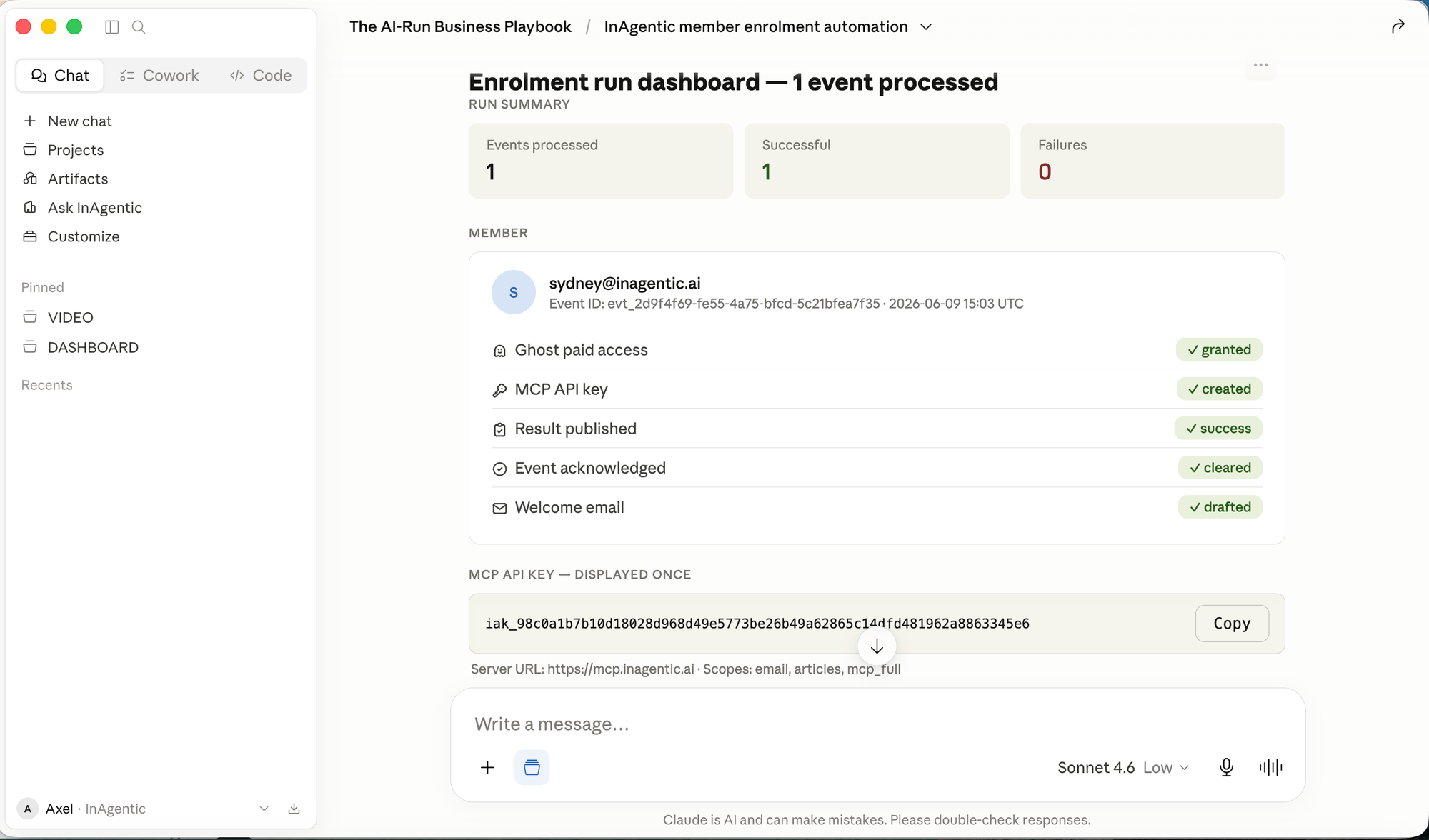
Three days, one complete agent. When someone joins as a member on Ghost, the enrolment agent handles the rest — Ghost access granted, MCP API key created, welcome email drafted and queued for approval — in under 30 seconds, no human in the loop.
Part 1 — Architecture Ghost fires a webhook. SQS captures it with full durability. An MCP server exposes the queue to Claude as tools. Claude reads events, reasons about what should happen, and outputs structured actions. SQS was chosen for near-zero operational overhead — the complex work lives in the agent layer, not the messaging layer.
Part 2 — Intelligence and execution, kept separate The provisioning worker executes one explicit instruction at a time. It has no opinion about what to do or when. Claude does the reasoning. The worker does the doing.
"The worker is a tool. Claude is the person deciding which tool to pick up, when, and why."
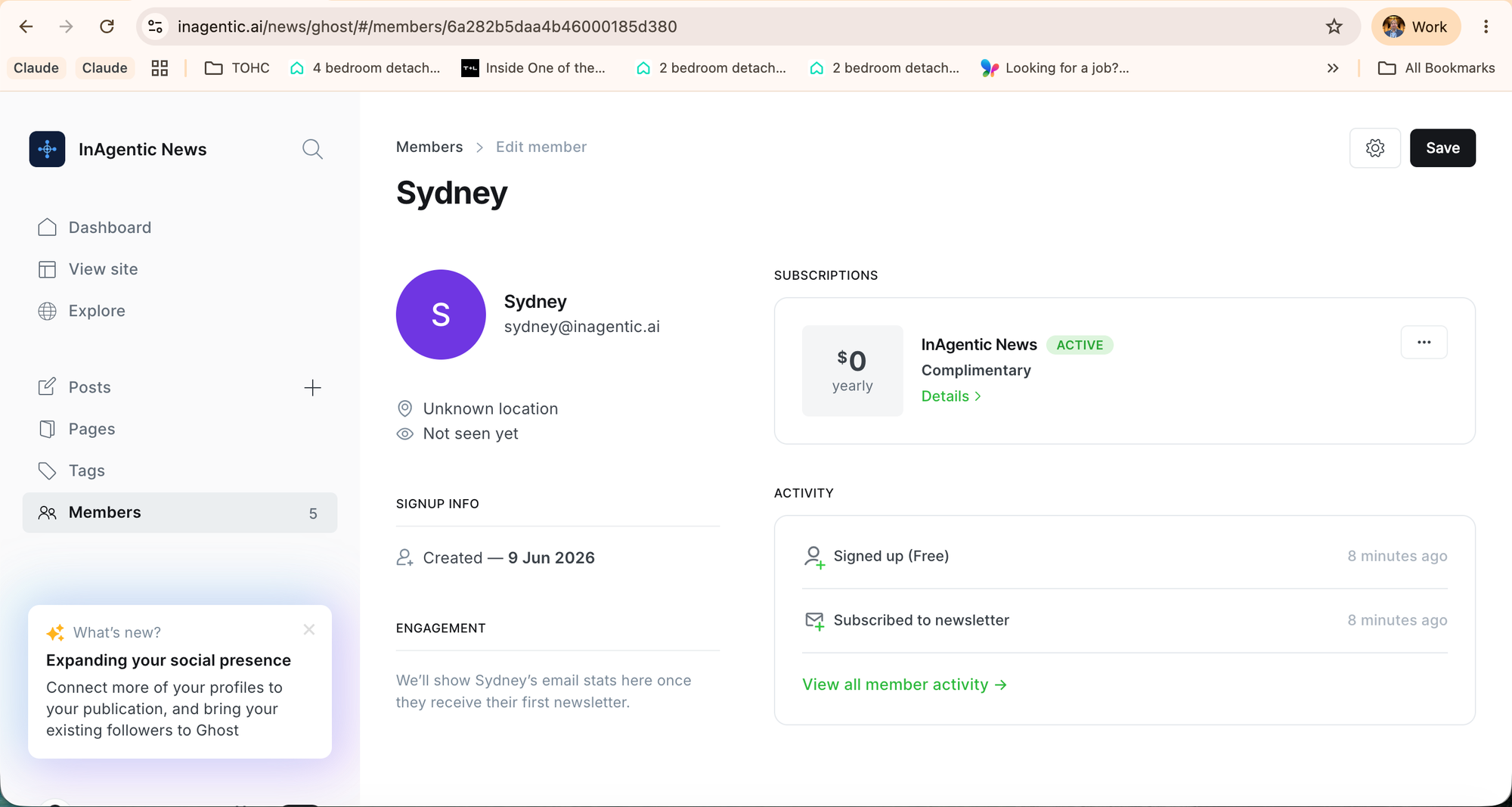
Part 3 — Production The full loop wired up: event queue, scheduler triggering the agent every five minutes, result log. A test member (Sydney) created in Ghost Admin. The dashboard confirmed every step within seconds — Ghost access granted, MCP API key created, welcome email drafted, event cleared.
Principles from week 1
01 — Start in Claude Desktop, move to LangGraph when you need to. Prove the logic first. No prize for going straight to code if a well-prompted agent does the job. But don't try to force Claude Desktop to do something it isn't built for.
02 — Keep intelligence and execution in separate layers. The agent reasons. The worker executes. This is what makes the system maintainable as it scales — swap one without touching the other.
03 — AI is assistive, not authoritative. Reversible outputs complete autonomously. Irreversible actions produce a draft and halt. The human confirms before anything executes.
04 — Instrument everything. LangSmith on every run. Audit logs on every state change. When something goes wrong in production, you need to know why within seconds.
05 — When Claude Code gets stuck, reset and guide it. Start a new chat with a clear, minimal goal. Break big tasks into small steps. You are orchestrating, not delegating blindly.
— Jon Axel inagentic.ai · jon@inagentic.ai